The Network Was Built on Trust
Lecture 6 ended on TLS protecting the channel. This lecture is the channel itself: what the network believes, and who can lie to it.
- TCP/IP was designed for a small research network where every operator knew every other operator. Authentication was not an omission — it was out of scope
- Consequences we still live with:
- A source IP address is a claim
- An ARP reply is believed by whoever hears it
- A DNS answer is accepted if it arrives first
- A BGP route announcement is accepted because a peer said so
- Everything in this lecture is a patch over that original assumption
In the Wild: Pakistan Telecom and YouTube, 2008
- 24 February 2008: to block YouTube at home, Pakistan Telecom announced
208.65.153.0/24. Its upstream, PCCW, passed it on to the world - YouTube announced the wider
/22. Routers prefer the most specific route, so the world's YouTube traffic went to Pakistan - The claim from the slide before: no router asked whether that network had the right to announce the prefix. It was over in about two hours, when PCCW withdrew the route
- What stops it: an upstream that filters what its customers may announce, and RPKI — signed records of who may originate which prefix, checked by the routers
A hijacker gets the packets, not the certificate — TLS from lecture 6 still holds.
Source: RIPE NCC, YouTube Hijacking: A RIPE NCC RIS case study
Passive: Listening
- Sniffing — read traffic you can reach. Trivial on shared media and on any network you have a port on
- Switches made it harder by accident, not by design: a switch forwards by
MAC address, so you only see your own traffic
- Until MAC flooding overflows the switch's address table and it fails open, broadcasting everything
- The defence is not "stop them listening" — it is encryption, so that listening gains nothing. Lecture 1's rule for passive attacks: prevent, do not detect
Active: Lying
- ARP spoofing — ARP maps an IP address to
a MAC address on the local network, and hosts cache any reply. Announce
that your MAC owns the gateway's IP, and you are the gateway
- ARP has no authentication at all. There is nothing to break
- DNS spoofing — answer the query before the real server does, or poison a resolver's cache so it lies to everyone behind it
- IP spoofing — forge the source address. Easy for UDP; harder for TCP, which needs the sequence number
- All three build the same thing: a machine in the middle
ARP Spoofing, Drawn
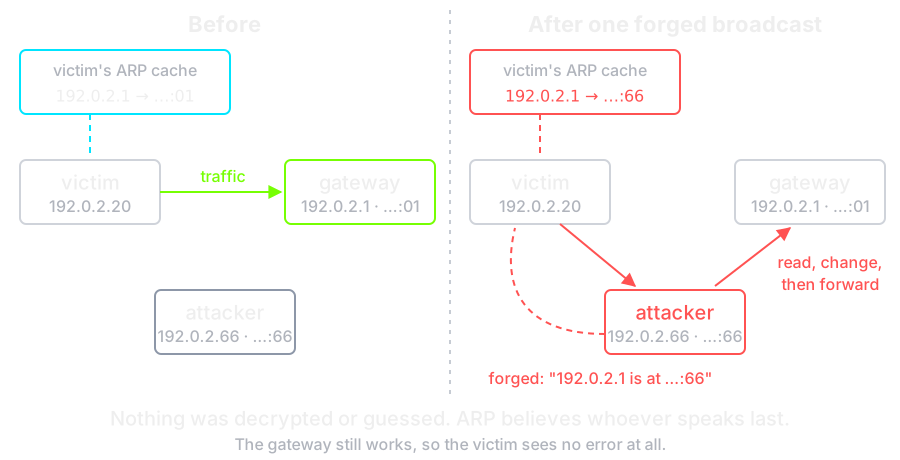
ARP Spoofing, in One Broadcast
Three network namespaces on one bridge, inside a container with no network attached — the lab rule from lecture 1, kept.
$ victim ping -c 1 -q 192.0.2.1 > /dev/null
$ victim ip neigh show 192.0.2.1
192.0.2.1 dev eth0 lladdr 02:00:00:00:00:01 REACHABLE
$ attacker ip addr add 192.0.2.1/32 dev eth0
$ attacker arping -U -c 1 -I eth0 192.0.2.1
ARPING 192.0.2.1 from 192.0.2.1 eth0
Sent 1 probes (1 broadcast(s))
Received 0 response(s)
$ victim ip neigh show 192.0.2.1
192.0.2.1 dev eth0 lladdr 02:00:00:00:00:66 STALE
$ victim ping -c 1 192.0.2.1 | tail -2
1 packets transmitted, 1 received, 0% packet loss, time 0ms
rtt min/avg/max/mdev = 0.095/0.095/0.095/0.000 ms
- One unauthenticated packet rewrote the victim's cache. The ping still succeeds — it is the attacker answering, and nothing says so
In the Wild: Kaminsky's DNS Attack, 2008
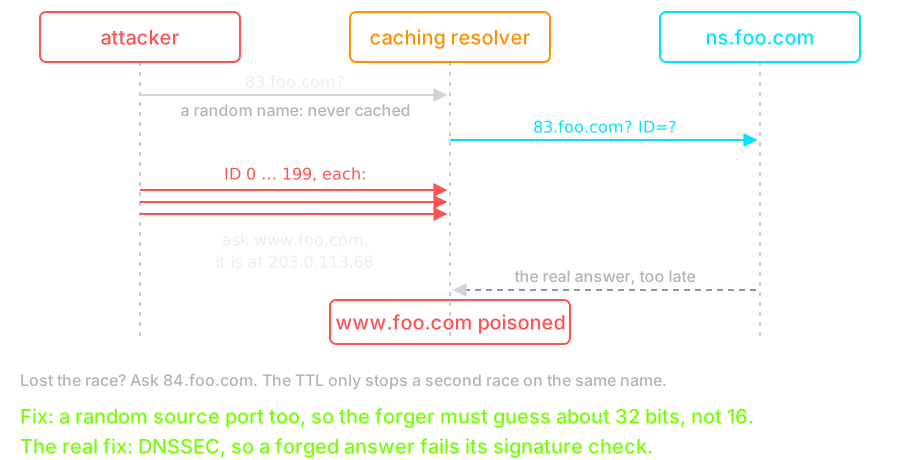
- DNS spoofing from Active: Lying, made reliable. A resolver accepted the first answer that matched a 16-bit query ID, and some sent every query from one fixed port
- The TTL was meant to limit the attacker to one race per name until the record expired. Kaminsky asked for names that were never cached, so every query was a new race
- The winning forgery did not answer the question asked. It said "ask
www.foo.com, it is here" — and the resolver cached the lie for everyone behind it - Fixed in a coordinated patch on 8 July 2008 (CVE-2008-1447): random source ports. Only DNSSEC makes a forged answer detectable
Sources: CERT/CC, VU#800113, Multiple DNS implementations vulnerable to cache poisoning · Dan Kaminsky, Black Hat Japan 2008
Kaminsky's Race, Drawn
What the Middle Buys
- Read everything · change everything · impersonate either side
- Against plaintext this is total. Against TLS it is much less — the attacker can drop traffic, but cannot produce a certificate for the name
- Which is why the attack shifted to
stripping: keep the victim on
http://and there is no certificate to forge - And why HSTS from lecture 6 matters here — the browser refuses to be downgraded, so there is nothing to strip
- Layer 2 answers exist too: dynamic ARP inspection and DHCP snooping on the switch, which drop the forged replies before anyone hears them
Denial of Service
| Volumetric | Fill the pipe. Measured in bits per second |
| Protocol | Exhaust a state table — a SYN flood opens connections it never finishes. Measured in packets per second |
| Application | Ask for the expensive thing. A few requests per second can be enough |
- Amplification is what makes the first one cheap: send a small query with a forged source, and the server sends a large answer to the victim
- UDP services with no handshake are the reflectors — DNS, NTP, memcached. US-CERT TA14-017A tabulates the factors, and they run from tens to tens of thousands
- You cannot absorb a volumetric attack on your own link. That defence is bought upstream
In the Wild: GitHub and memcached, 2018
- 28 February 2018: GitHub received 1.35 Tbps — the amplification from the slide before, reflected off memcached servers left open to the internet on UDP
- A forged source address and a factor of up to 51,000: one byte sent, up to 51 KB delivered to GitHub
- GitHub's own link could not take it. It moved its traffic to Akamai's scrubbing network — the defence bought upstream — and was fully back within ten minutes of the alert
- What stops it at the source: memcached off UDP and off the internet, and networks that drop packets with forged source addresses
Reconnaissance
- Before any of the above: what is here, and what is listening?
- Host discovery, then port scanning, then banner grabbing to name the version, then a lookup of what that version is vulnerable to
- On the public internet this is continuous and automated. A new address receives its first scan within minutes
- Which reframes the defence: you cannot avoid being found, so reduce what is findable — the attack surface argument from lecture 1, applied to open ports
In the Wild: Mirai and Dyn, 2016
- Mirai scanned the internet for Telnet and logged in with a list of 62 default usernames and passwords — cameras, routers, recorders. It peaked at about 600,000 devices
- 21 October 2016: it flooded Dyn, a DNS provider. Sites that used Dyn — GitHub, Netflix, PayPal, Reddit, Twitter — stayed up, but their names no longer resolved
- The slide before, automated: scan, find, log in. The failure is lecture 4's — a default password is no authentication at all
- The grade service is only as available as its name: a second DNS provider is a defence too
Source: Antonakakis et al., Understanding the Mirai Botnet, USENIX Security 2017
Zoning
- A security zone is a group of systems with the same trust level and the same policy
- Grouping by trust rather than by geography or department is the whole idea — a laptop in the building is not more trusted than one outside it
- Traffic within a zone flows freely. Traffic between zones is controlled, inspected and logged
- This is lecture 2's boundary drawing, made concrete in addresses and interfaces
The Classic Layout
| Untrusted | The internet. Assume hostile |
| DMZ | Public-facing services. Reachable from outside, and trusted by nobody |
| Internal | Workstations and internal applications |
| Restricted | Databases, domain controllers, key material |
| Management | Switch and hypervisor consoles, out-of-band cards. The keys to everything |
The rule that gives the DMZ its value: a DMZ host initiates nothing inward, except flows written down by name. Compromising the web server then buys the attacker one machine.
The Grade Service, Zoned
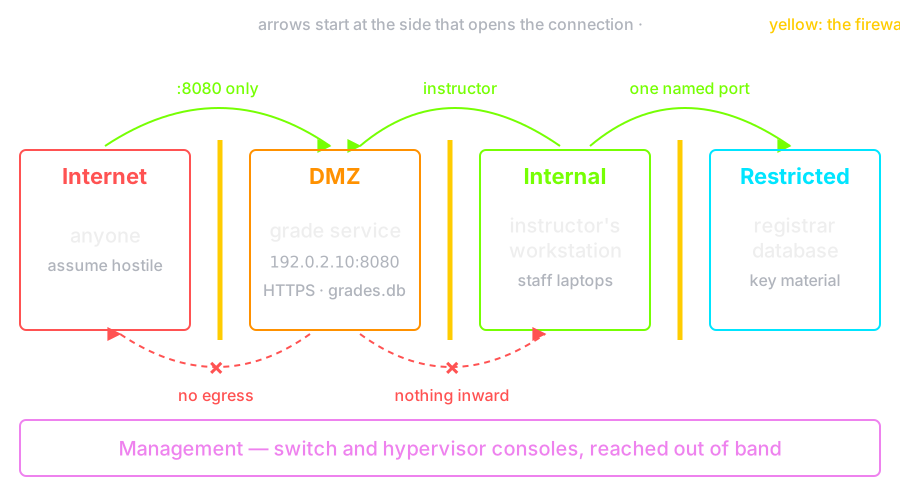
The grade service faces the internet, so it lives in the DMZ. Its SQLite file sits beside it, so it needs no inward flow — and whoever takes this host takes every grade. A database server would go in Restricted, reached by one named flow.
North-South and East-West
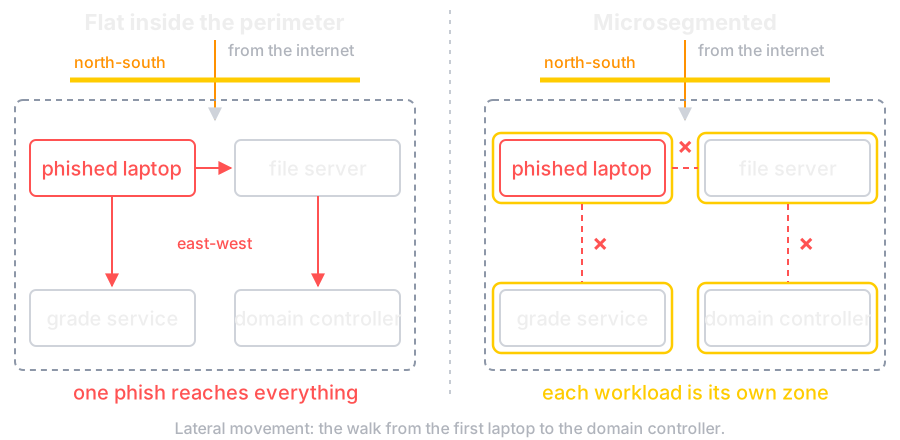
- North-south — traffic crossing the perimeter. Historically where every control was placed
- East-west — traffic between internal hosts. Historically unfiltered, unlogged, and far larger in volume
- Which is exactly the path an intruder uses. Lateral movement is the phase between the first compromised laptop and the domain controller
- Microsegmentation pushes policy down to the individual workload, so east-west traffic gets the same treatment north-south always had
North-South and East-West, Drawn
In the Wild: Target, 2013
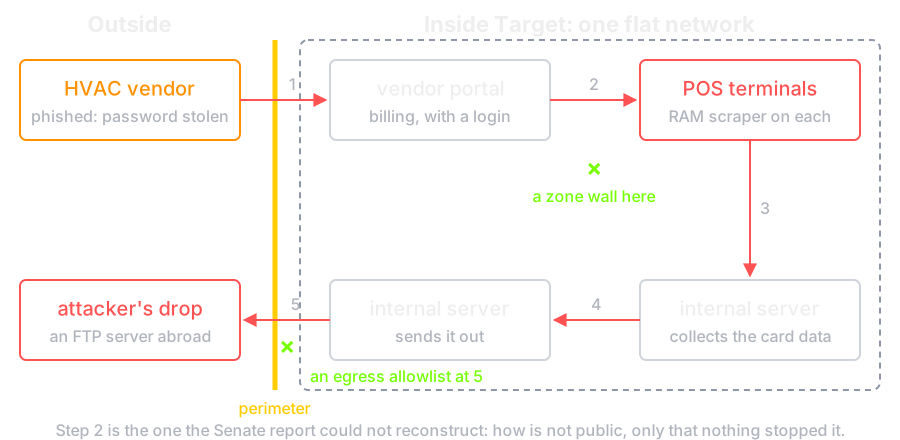
- Attackers phished an HVAC contractor and took its login to a Target system for vendors' billing. From there they reached the point-of-sale terminals in Target's stores. Lecture 5 showed the alarms nobody read; here is the path they warned of
- About 40 million card numbers and up to 70 million customer records left — over FTP, to servers outside, for two weeks
- The flat network from the slide before: the US Senate report found that Target "failed to properly isolate its most sensitive network assets"
- What stops it: the vendor portal in its own zone with no path to the tills, and an egress allowlist — next section — naming the few places the tills may send to
Source: US Senate Commerce Committee, A "Kill Chain" Analysis of the 2013 Target Data Breach (2014)
Target, Drawn
Zero Trust
Never trust, always verify. Location is not a credential.
- The perimeter model assumes inside is safe. Remote work, cloud services and phones on the corporate wifi ended that assumption
- Zero trust replaces it with per-request decisions:
- Authenticate the user and the device, every time
- Authorize the specific resource, not the network
- Assume breach — design as though the attacker is already inside
- NIST SP 800-207 is the reference. It is a direction, not a product, whatever the vendor says
Zero Trust, Drawn
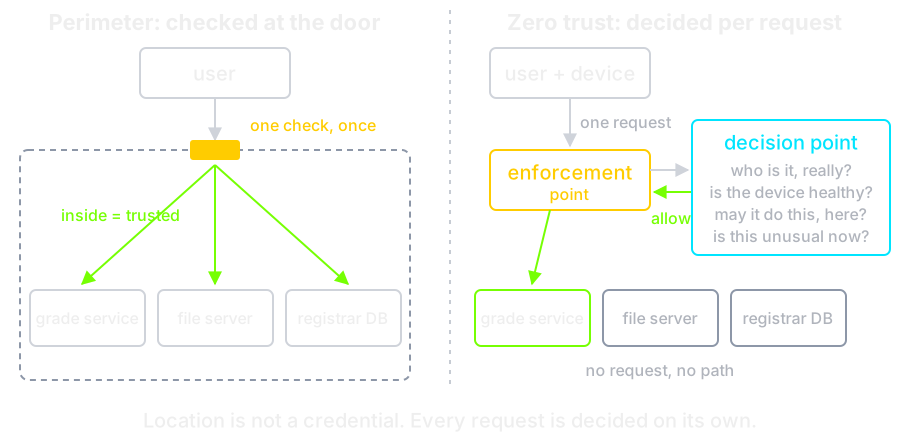
The decision point and the enforcement point are NIST SP 800-207's own
names. Lecture 4's allow(s, a, o), asked on every request.
In the Wild: Operation Aurora, 2009
- Late 2009: an intrusion into Google, which Google attributed to the Chinese government, ended in the theft of intellectual property. Several other large companies were targeted too
- Google's lesson was the one on Zero Trust: once an attacker is inside the perimeter, the privileged intranet trusts them
- Its answer was BeyondCorp: no privileged intranet at all. Every request is checked for user and device, from any network, without a VPN
- The decision point from the slide before, built at the scale of a whole company — and published, so others could copy it
Sources: Google, Transparency in the shadowy world of cyberattacks (2022) · Ward and Beyer, BeyondCorp: A New Approach to Enterprise Security, ;login: 2014
What a Firewall Is
- A choke point between two zones where a policy is enforced and traffic is logged
- The value comes from being the only way through. A firewall with a route around it is decoration
- And from default deny: permit what is needed, drop the rest. The opposite ordering is a list of things you happened to think of
Three Generations
| Packet filter | Each packet judged alone, by address and port. Fast, and cannot tell a reply from an unsolicited packet |
| Stateful | Tracks connections, so replies are allowed and unsolicited packets are not. The baseline everywhere |
| Application layer | Understands the protocol. A proxy terminates the connection and makes its own |
- Next-generation adds identity and application awareness, so a rule can say "the finance group may reach the ERP" rather than naming subnets
- A WAF (web application firewall) is an application-layer firewall for HTTP. It buys time to patch; it does not fix the code from lecture 6
Egress Filtering
- Almost everyone filters inbound. Far fewer filter outbound, and that is where the detection value is
- Malware has to call home; stolen data has to leave. Both are outbound connections from a host that has no business making them
- A database server that suddenly opens an HTTPS connection to an unknown address is a high-quality signal — rare enough to beat the base-rate problem from lecture 5
- Force outbound traffic through a proxy that authenticates and logs, and deny direct routes
The Rule Base, Written
The zones of the grade service, as network namespaces in a container with
no network attached. The firewall's forward chain, loaded with
nft -f before each run:
table inet fw {
  chain forward {
    type filter hook forward priority 0; policy drop;
    ct state established,related accept
    # the internet may reach the grade service, and nothing else
    iifname "out" ip daddr 192.0.2.10 tcp dport 8080 counter accept
    # the internal zone may reach the DMZ
    iifname "lan" oifname "dmz" counter accept
    # the DMZ initiates nothing: not inward, not outward
    iifname "dmz" counter drop
    counter drop
  }
}
Default deny is the policy; the last rule only counts what it drops. The DMZ rule above it is the egress filter from the slide before.
Five Connections, Five Answers
$ internet curl --cacert cert.pem -c jar -d name=4001 \
       -d password=tulip-river-42 https://192.0.2.10:8080/login
hello 4001
$ internet curl --cacert cert.pem -b jar 'https://192.0.2.10:8080/grades?course=IS'
4001 IS 12
$ dmz nc -zv -w 2 203.0.113.10 5432
nc: connect to 203.0.113.10 port 5432 (tcp) timed out: Operation now in progress
$ dmz nc -zv -w 2 198.51.100.20 443
nc: connect to 198.51.100.20 port 443 (tcp) timed out: Operation now in progress
$ internet nc -zv -w 2 203.0.113.10 5432
nc: connect to 203.0.113.10 port 5432 (tcp) timed out: Operation now in progress
$ fw nft list chain inet fw forward | grep -o 'iifname.*\|counter.*'
iifname "out" ip daddr 192.0.2.10 tcp dport 8080 counter packets 2 bytes 120 accept
iifname "lan" oifname "dmz" counter packets 0 bytes 0 accept
iifname "dmz" counter packets 4 bytes 240 drop
counter packets 2 bytes 120 drop
internet,dmz,fwrun the command in that zone. The grade service is lecture 6's, over HTTPS with a certificate for192.0.2.10;ncon:5432stands in for an internal database- The DMZ rule counted 4 packets: two tries, each sent twice. A DMZ host that tries at all is news — that counter is the alarm
In the Wild: SolarWinds SUNBURST, 2020
- Attackers put a backdoor into signed updates of SolarWinds Orion, a network monitoring product. Fewer than 18,000 customers installed one
- After up to two weeks asleep, it looked up a name under
avsvmcloud[.]com, then talked HTTP dressed as Orion's own telemetry - Each call home was an outbound connection from a server with no business on the internet — the DMZ counter on the slide before
- The responders' advice was this rule: block all internet egress from Orion servers. Count DNS as egress — the first call home was a lookup
Sources: FireEye (Mandiant), Highly Evasive Attacker Leverages SolarWinds Supply Chain · SolarWinds, Form 8-K, 14 December 2020
Rules, and How They Go Wrong
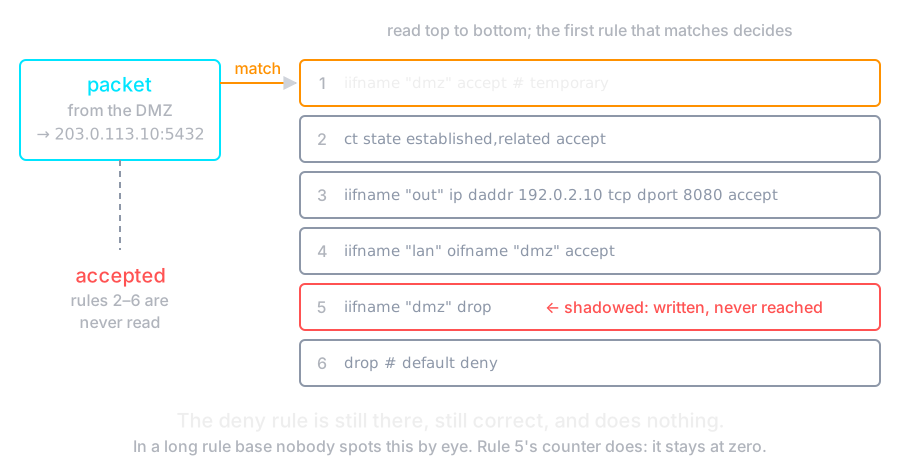
- Rules are evaluated in order, first match wins. A broad rule near the top silently shadows everything below it
- The final rule is
deny all, and it should log - Rule rot is the real failure: a "temporary" any-any rule from a migration three years ago that nobody dares remove
- Review the rule base on a schedule, with an owner and a justification per rule
- NAT is not a firewall. It hides addresses as a side effect of running out of them, and it is not a policy
First Match Wins, Drawn
One Temporary Rule
The same rule base, plus one line from a migration:
$ fw nft insert rule inet fw forward iifname dmz counter accept comment temporary
$ dmz nc -zv -w 2 203.0.113.10 5432
Connection to 203.0.113.10 5432 port [tcp/*] succeeded!
$ fw nft list chain inet fw forward | grep -o 'iifname.*'
iifname "dmz" counter packets 4 bytes 216 accept comment "temporary"
iifname "out" ip daddr 192.0.2.10 tcp dport 8080 counter packets 0 bytes 0 accept
iifname "lan" oifname "dmz" counter packets 0 bytes 0 accept
iifname "dmz" counter packets 0 bytes 0 drop
- The DMZ reaches the database. The deny rule is still there, still correct, and its counter says 0
- A rule that never matches is a finding. Review the counters, not just the text
Where Detection Sits
- IDS (intrusion detection system) observes a copy of the traffic and alerts. It cannot be a bottleneck and cannot stop anything
- IPS (intrusion prevention system) sits inline and can drop. Which means a false alarm is now an outage, and the device is a single point of failure
- Placement decides what you see: outside the firewall shows you the internet's noise, inside shows you what got through. Inside is the useful one
- And the modern limitation: most traffic is encrypted. Either you terminate TLS at a proxy — with all the trust and privacy questions that raises — or you inspect metadata and move detection to the host
Controlling Who Gets On
- A network port in a meeting room is a connection to the internal zone, offered to anyone who sits down
- 802.1X authenticates the
device or user before the port carries any traffic
- Supplicant (the client) → authenticator (the switch or access point) → authentication server (RADIUS)
- Until it succeeds, the port passes nothing but the authentication exchange itself
- NAC (network access control) adds a posture check — patched, encrypted, running the agent — and can drop a failing device into a remediation VLAN
- Port security on the switch limits how many MAC addresses a port may learn, which is the cheap answer to MAC flooding
VPN
- A cryptographically protected tunnel across a network you do not control. It buys back confidentiality, integrity and peer authentication — the X.800 services, applied to a whole link
- Two shapes, for two problems:
- Site-to-site — two offices joined through routers. Users never know it is there
- Remote access — one device joining from anywhere
- What it is not: a defence against anything on either end. A compromised laptop on a VPN is a compromised laptop inside your network
In the Wild: Pulse Secure and Ivanti, 2019–2024
- The VPN box is itself a host on the internet. Pulse Secure's CVE-2019-11510 let anyone, with no login, read files from it — including the credentials of the users who had logged in
- Patched in April 2019, yet CISA kept finding intruders who logged in months later with credentials stolen before the patch
- January 2024, the same product line under a new name: an authentication bypass chained with command injection in Ivanti Connect Secure. CISA ordered US agencies to mitigate within three days, then to unplug every such box
- So the gateway belongs in the DMZ, patched first, with MFA — and after a breach, patching is not enough: reset every credential it held
Sources: CISA, AA20-107A · CISA, Emergency Directive 24-01
IPsec
- Security at the IP layer, so every protocol above it is covered
- Two protocols, and only one is used:
- AH — integrity and authentication, no encryption. Rarely deployed
- ESP — encryption plus integrity. This is the one
- Two modes, and the difference is what gets hidden:
- Transport — protects the payload, leaves the original header. Host to host
- Tunnel — wraps the entire packet in a new one, so the inner addresses are hidden too. Gateway to gateway
- IKEv2 (Internet Key Exchange) does the authentication and key agreement, and rekeys on a timer
Transport and Tunnel, Drawn
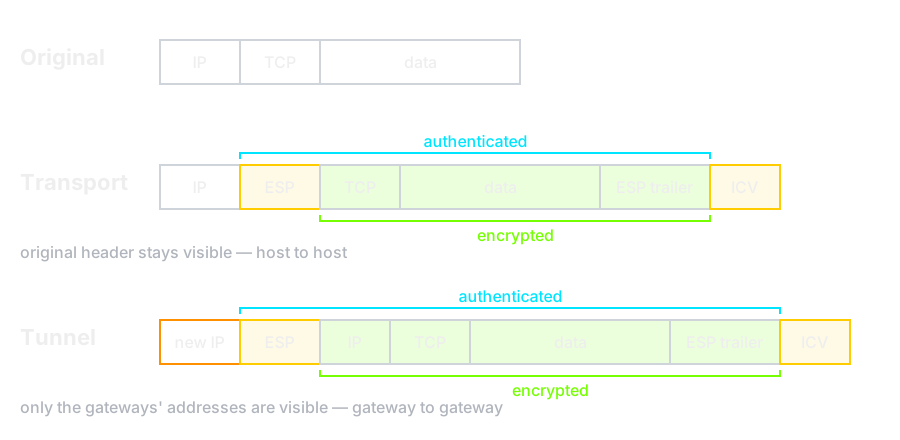
Both modes encrypt the payload. Only tunnel mode hides who is talking to whom — which is why site-to-site VPNs use it.
The Other Options
| IPsec | Standard, interoperable, complex. The default for site-to-site |
| TLS VPN | Runs over 443, so it crosses restrictive networks. OpenVPN and most vendor clients |
| WireGuard | A few thousand lines, one fixed cipher suite, in the kernel. Small enough to audit |
- WireGuard's design choice is worth naming: it is not negotiable. No cipher negotiation means no downgrade attack and no misconfiguration
- Split tunnelling — only some traffic goes through the VPN. Saves bandwidth, and bridges the internet to your internal network through the client
VLAN
- One physical switch, several independent broadcast domains. Ports are assigned to a VLAN, and traffic between VLANs must pass a router
- Which makes that router the choke point — VLANs are how zoning gets implemented without buying a switch per zone
- 802.1Q adds a 4-byte tag carrying a 12-bit VLAN ID — so 4094 usable VLANs
- Two kinds of port, and the distinction causes most VLAN incidents:
- Access port — one VLAN, untagged. Where a host plugs in
- Trunk port — many VLANs, tagged, except one untagged native VLAN. Between switches
VLAN Hopping
- Switch spoofing — the attacker's host
pretends to be a switch and negotiates a trunk, receiving every VLAN
- Fix: disable automatic trunk negotiation, and set every user-facing port to access mode explicitly
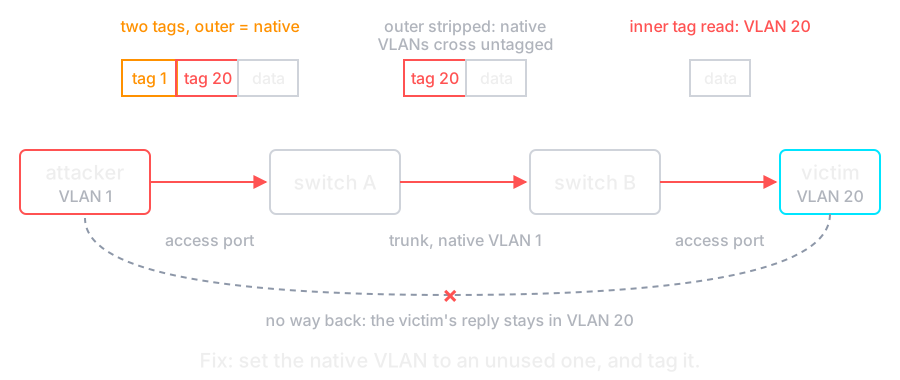
- Double tagging — send a frame with two tags.
The first switch strips the outer one and forwards it; the second reads
the inner tag and delivers it to a VLAN the attacker cannot reach
- It works because the native VLAN is carried untagged. Fix: make the native VLAN an unused one, and tag it
- Note the direction — double tagging is one-way. Enough to attack, not to converse
Double Tagging, Drawn
What a VLAN Is Not
A VLAN is segmentation. It is not encryption, and it is not a firewall.
- Traffic inside a VLAN is plaintext, and anyone on that VLAN can hear the broadcast domain
- The separation is enforced by switch configuration — so it is exactly as strong as the switch's management access
- Which is why the management zone exists: whoever reaches the switch console owns every VLAN on it
- Private VLANs go further, isolating ports even within one VLAN — useful in a DMZ, where two web servers have no reason to talk to each other at all
Check Yourself
- After one forged ARP broadcast, the victim's ping still succeeds. Why is that worse than a failed ping?
- The grade service sits in the DMZ with
grades.dbbeside it. Name one flow the firewall allows, one it denies, and what an attacker gets by taking that host - In One Temporary Rule, the deny rule was still in the list. Why did it not stop the connection, and how would a review notice?
- A laptop with malware connects over the VPN. Which services does the tunnel still give, and what does it not protect?
Putting the Course Together
- Lecture 1 named the properties. Lecture 2 turned them into services, policy and risk
- Lecture 3 built the toolbox; lecture 4 decided who may do what
- Lectures 5 to 7 spent it — on the host, the application and the network
- The same few ideas kept reappearing: least privilege, default deny, defence in depth, and data must never become code
Name the property. Name the threat. Then pick the mechanism — and know what it does not do.