One Machine, Many Tenants
Lecture 4 asked allow(s, a, o) about a person. Here the
subject is a process, the object is a file, a device or memory —
and the kernel answers.
- An operating system exists to let mutually distrusting programs share one machine. That is a security job before it is a convenience
- Everything rests on a hardware boundary the software cannot talk its way past: user mode and kernel mode
- A user-mode program cannot touch another process's memory, a device, or the page tables. It can only ask, through a system call
- The system-call boundary is therefore the most attacked interface on the machine
Trusted Computing Base
- The TCB is everything that has to be correct for the security policy to hold
- Kernel, drivers, firmware, the bootloader, every setuid binary (lecture
4's
sbit) - A bug inside the TCB defeats the policy. A bug outside it does not — that is the entire reason for drawing the line
- So: keep it small. A driver from an unknown vendor is in your TCB with full kernel rights
Lecture 2 called this "trusted functionality" and told you to keep it small. This is what it looks like in practice.
In the Wild: CrowdStrike Falcon, 2024
- 19 July 2024: a content update to CrowdStrike's Falcon sensor crashed about 8.5 million Windows machines
- The sensor runs as a kernel driver — in the TCB. Its update expected 21 input fields and got 20, and read past the end of the array — section 4's bug
- In user mode that is one dead process. In the kernel, it is the whole machine
- The vendor's fixes: a bounds check, and staged rollout instead of everyone at once
A security tool is in the TCB too — and so is its bug.
Source: CrowdStrike, Channel File 291 Root Cause Analysis; Microsoft, Helping our customers through the CrowdStrike outage
In the Wild: The xz Backdoor, 2024
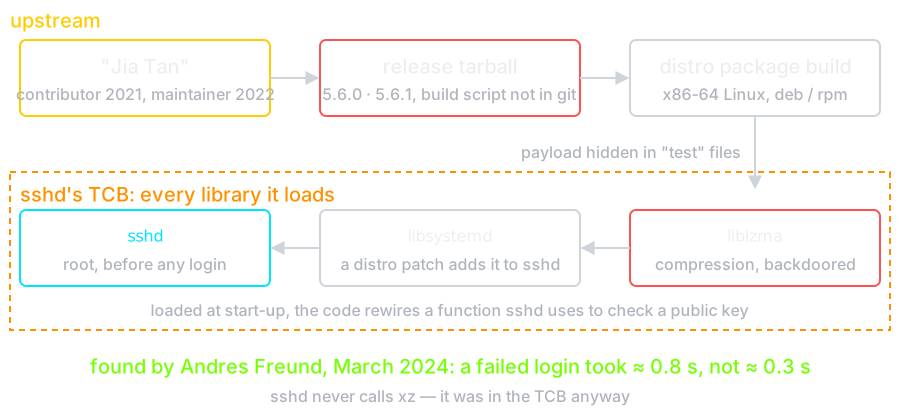
- A contributor spent two years earning maintainer rights on
xz, a compression library, then shipped a backdoor in releases 5.6.0 and 5.6.1 (CVE-2024-3094) sshdnever uses compression — but on several distributions it loadslibsystemd, which loadsliblzma- Your TCB is not the code you wrote. It is every library the trusted process loads, and everyone who can publish one
- Caught while it was mostly in pre-release distributions, because an engineer chased half a second of extra login time
Source: Andres Freund, backdoor in upstream xz/liblzma (oss-security); Russ Cox, Timeline of the xz open source attack
The xz Backdoor, Drawn
The Reference Monitor
- The idealised access-control enforcer. Three requirements:
- Complete mediation — lecture 1's principle: every access goes through it, with no side door
- Tamper-proof — nothing it governs can modify it
- Verifiable — small enough that it can be analysed
- Real kernels approximate all three and achieve none exactly, which is why the rest of this lecture exists
The Boundary, Drawn
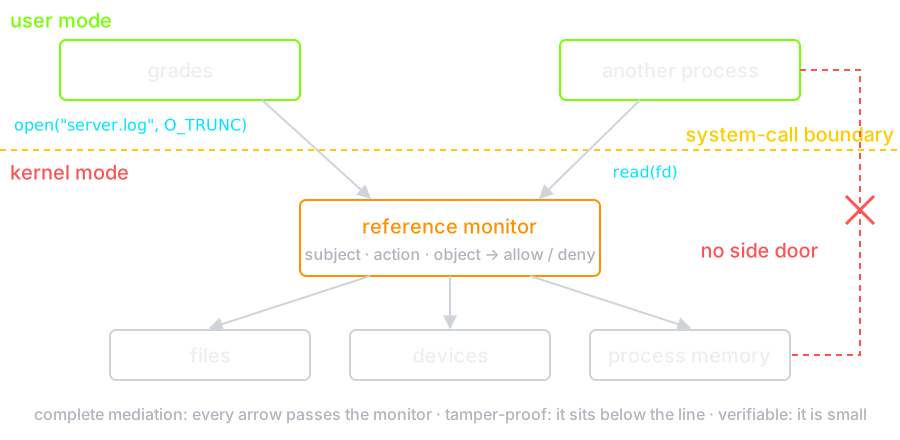
When the grade service opens its log, the decision is made here — not in a line of Go.
Hardening
- Patch. The overwhelming majority of compromises use a vulnerability that had a fix available
- Remove. Uninstall what is not used; disable the services that start by default
- Separate. One service per account, none of them root
- Default deny on the host firewall, inbound and outbound
- Measure. A benchmark you can re-run — the CIS Benchmarks exist for exactly this
Ask it of the grade service: which account runs ./grades,
and what else can that account touch? Mostly, the answer is files.
The File System Is the Database
- Configuration, credentials, keys, logs and the data itself all live in one namespace governed by one mechanism
- Lecture 4 gave the model. Here it is the operational detail:
- Sensitive files should be
0600, owned by the service account - Directories need
xto traverse — a permissive parent undoes a strict child - Audit setuid binaries. Each one is a place a local user becomes another user
- Sensitive files should be
- The mistakes that recur: a world-readable key, a backup written with the
wrong
umask, a config committed to git
Encryption at Rest
- Full-disk encryption — FileVault, LUKS, BitLocker. Protects against the stolen laptop and the discarded disk
- Be precise about what it does not do: once the machine is running and unlocked, every file is readable by anyone who is on it. It defends a powered-off device
- File- or field-level encryption narrows the window further, at the cost of key management in the application
- The key has to live somewhere: a TPM or secure enclave, released to the boot process — not a passphrase in a script beside the disk
Knowing When It Changed
- File integrity monitoring: hash the files that should never change, and compare on a schedule
- Binaries, configuration, cron jobs, startup scripts, the web root
- The baseline has to be stored where the attacker cannot reach it, or they will update it along with the file — lecture 1's "Who guards the digest?" again
- Tripwire and AIDE do this. So does a package manager verifying its own database, which most systems already have
The Service Can Rewrite Its Own Log
Lecture 1's grade service, first version, running as
./grades 2>> server.log:
$ curl -s -H 'X-User: 4001' -d 'id=4001&grade=20' localhost:8080/grade
4001 is now 20
$ cat server.log
2026/10/14 09:50:41 grade 4001=20 by 4001
$ sed -i '' '/by 4001/d' server.log
$ wc -l < server.log
0
- Whoever runs as the service's account — through a bug, or a stolen shell — owns the log too
- Lecture 2's "The Day It Happens" reads exactly this line. After the
sed, there is nothing to read
Append-Only, and Who Can Lift It
$ chflags uappnd server.log
$ curl -s -H 'X-User: 4001' -d 'id=4001&grade=20' localhost:8080/grade
4001 is now 20
$ sed -i '' '/by 4001/d' server.log
sed: rename(): Operation not permitted
$ cat server.log
2026/10/14 09:50:50 grade 4001=20 by 4001
$ chflags nouappnd server.log
- The service can still append. It can no longer rewrite or delete
- But
uappndis the owner's flag — the last line removes it, with no error - The wall that holds is a different owner:
root sets
sappnd(chattr +aon Linux), or the log leaves for another host as it is written
The process that writes the record must not own it.
Every check here trusts the program that runs as you. Next: the program that does not deserve it.
Malware, Sorted
Sort by how it spreads, not by what it does:
| Virus | Attaches to a host file. Needs a user to run it |
| Worm | Self-propagating over the network. Needs nobody |
| Trojan | Useful-looking, and the user installs it deliberately |
| Rootkit | Hides the others, usually by lying to the kernel |
| Bot | Waits for orders from a command-and-control server |
Then, separately, the payload: ransomware, spyware, a miner, a wiper, a keylogger. Any spreader can carry any payload.
Why the Worm Is Different
- Everything else moves at human speed. A worm moves at network speed
- Morris, 1988 — a few thousand hosts, and it took down a noticeable fraction of the internet that existed
- Slammer, 2003 — a single UDP packet, no disk footprint, doubling every 8.5 seconds
- WannaCry, 2017 — ransomware payload on a worm spreader, using a leaked SMB exploit. A patch had been available for two months
- The defence is not detection. It is patching and segmentation — nothing human is fast enough to respond
In the Wild: Stuxnet, 2010
- A worm aimed at Siemens industrial controllers (PLCs); about 60% of the infected hosts Symantec counted were in Iran
- Its targets were not on the internet. It crossed the gap on USB drives, using a Windows shortcut bug that ran code as soon as the drive was browsed
- Four unpatched Windows vulnerabilities, drivers signed with two stolen certificates, and a rootkit on both Windows and the PLC
- An air gap is a wall with a door: every USB stick and every contractor's laptop. A signature proves which key signed, not who was holding it
Source: Falliere, O Murchu & Chien, W32.Stuxnet Dossier v1.4 (Symantec, 2011)
Ransomware, Because It Is What You Will Meet
- Encrypt the victim's files, sell the key. Purely a business model
- It is good cryptography used against you — asymmetric, so the key you need was never on your machine
- The modern version is double extortion: the data is exfiltrated first, so paying nothing means publication and paying anyway means trusting a criminal
- The attack targets your backups first, because it knows that is the defence
- Which makes the lecture 2 rule the technical control that matters here: one copy offline or immutable
In the Wild: NotPetya and Maersk, 2017
- Delivered through the update server of M.E.Doc, a Ukrainian accounting package, then spread with EternalBlue and stolen passwords (Mimikatz)
- It looked like ransomware and worked as a wiper. The White House put total damage at more than $10 billion
- Maersk rebuilt 4,000 servers and 45,000 PCs. Its ~150 domain controllers synced with each other, so all were wiped together
- The one survivor was in Ghana, offline because of a power cut. Two staffers relayed its disk to London by plane
A replica is not a backup. The offline copy has to be design, not luck.
Source: Andy Greenberg, The Untold Story of NotPetya (WIRED, 2018)
Detecting It
- Signature — match known bytes. Exact, and
useless against anything new
- Defeated by polymorphic malware, which re-encrypts itself per copy, and metamorphic, which rewrites its own instructions
- Heuristic — suspicious structure. Catches variants, and raises false alarms
- Behavioural — watch what it does when it runs. Enumerating and encrypting every document is hard to disguise, because it is the goal
- Sandbox — run it somewhere disposable first. Malware checks whether it is in one, so this is an arms race
Detection waits for the malware to arrive. How does it arrive? Mostly through a bug in a program you trusted.
The Oldest Bug
- C will happily write past the end of an array. Nothing checks, because checking costs a cycle
- The bytes past the end are not empty. They are the next thing in memory
- So the attacker's input stops being data and starts being state. Data crossed into control — keep that sentence; lecture 6 meets the same bug on the web
struct session {
  char name[16];
  int  is_admin;      /* the next field in memory */
};
Sixteen Bytes Is Sixteen Bytes
struct session s;
s.is_admin = 0;
strcpy(s.name, argv[1]);            /* no bound check */
printf("name=%-24s is_admin=%d\n", s.name, s.is_admin);
$ ./login parham
name=parham                   is_admin=0

$ ./login AAAAAAAAAAAAAAAAAAAA
name=AAAAAAAAAAAAAAAAAAAA     is_admin=1094795585
1094795585 is 0x41414141 — four of the
letter A. The name overflowed straight into the flag.
And With a Little Aim
$ ./login "AAAAAAAAAAAAAAAA$(printf '\x01')"
name=AAAAAAAAAAAAAAAA        is_admin=1
- Sixteen bytes of filler and one chosen byte. The program is now an administrator
- Nothing was hacked.
strcpydid exactly what it is documented to do - On the stack the interesting neighbour is not a flag but the return address — overwrite that and you choose where the function returns to
The Overflow, Drawn
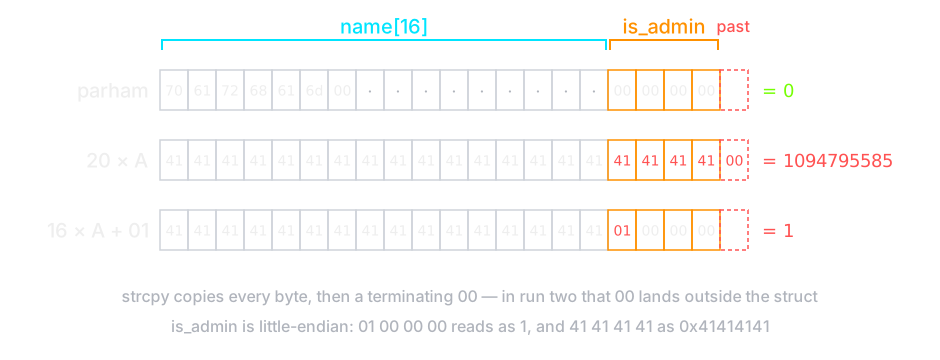
The dots are bytes nobody set. strcpy never asks where
name ends.
The Same Source, Compiled Defensively
Two checks the compiler adds: FORTIFY gives
strcpy the buffer size; a canary is a random value
beside the return address, checked before the function returns.
$ cc -O0 -o login-hardened login.c        # the defaults
$ ./login-hardened AAAAAAAAAAAAAAAAAAAA
exit=133          # SIGTRAP — __strcpy_chk knew the buffer was 16 bytes

$ cc -O0 -fstack-protector-all -o login-canary login.c
$ ./login-canary AAAA…40 bytes
exit=134          # SIGABRT — the canary was overwritten
- Not one line of the program changed. The compiler did the work
- Both mitigations turn a silent privilege escalation into a crash — which is a denial of service, and an enormous improvement
Layers of Mitigation
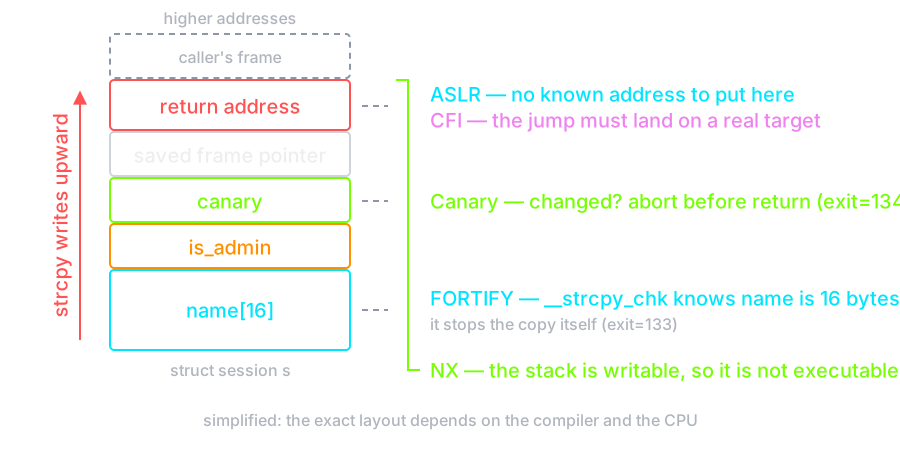
- Each raises the cost; none is a fix. NX produced return-oriented programming, which builds the payload out of code already in the binary
In the Wild: Heartbleed, 2014
- OpenSSL's TLS heartbeat: the client sends a payload and says how long it is; the server echoes that many bytes back
- OpenSSL never compared the claimed length with what arrived. Send one byte, claim 65,535, and receive up to 64 KB of server memory — keys, passwords, cookies (CVE-2014-0160)
- An over-read, so nothing on the previous slide fires: no canary is touched, nothing crashes, and the logs show nothing unusual
- The fix was one bounds check. Found independently by Google's Neel Mehta and by Codenomicon
Source: OpenSSL Security Advisory, 7 April 2014; Codenomicon, The Heartbleed Bug
Heartbleed, Drawn
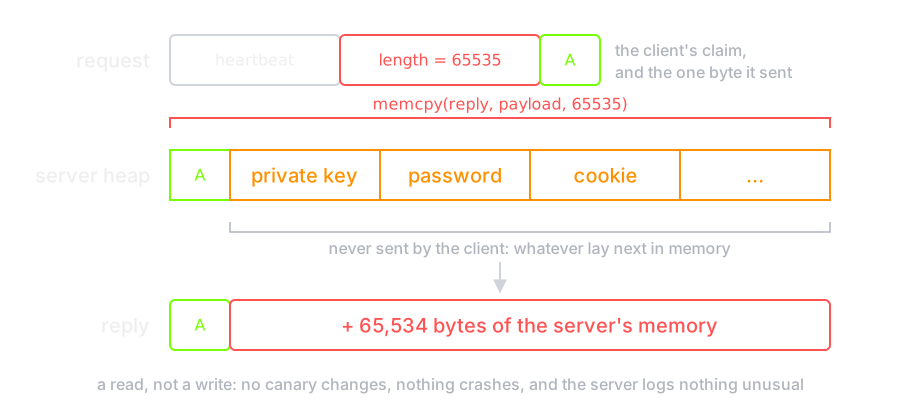
The length came with the data. Lecture 6 meets the same trust, one layer up.
The Actual Fix
- Use a memory-safe language where you can. Go, Rust, Java, Python — the bug class simply does not exist
- Microsoft and Google have both reported that around 70% of their severe vulnerabilities were memory-safety issues. Independently, in different codebases
- Where C is required: bounded functions, sanitizers in CI
(
-fsanitize=address,undefined), fuzzing, and review of every allocation - And the same discipline as everywhere else — validate at the boundary, and never trust a length that came with the data
Bugs will still ship. So the host must notice when one is used — and stop what it does next.
The Host Firewall
- The network firewall of lecture 7 protects a zone. This one protects the machine, and it is the one that still works when the attacker is already inside the zone
- Inbound: default deny, then allow the ports this host actually serves
- Outbound matters more than people expect. Malware has to reach its command-and-control server; a compromised database server has no business opening connections to the internet
pf,nftables, Windows Defender Firewall — the rules differ, the discipline does not
Host-Based Intrusion Detection
- A HIDS sees what the network cannot: which process, which user, which file, which syscall — and it sees it after decryption
- A NIDS sees the whole segment from one place, and is invisible to the host it is watching
- They are complements, not alternatives
- Two detection strategies, with opposite failure modes:
- Misuse — match known-bad, the signatures of the Malware section. Precise; blind to the new
- Anomaly — model normal, alert on deviation, like behavioural detection. Catches the new; buries you in false alarms
Why "99% Accurate" Is Not Good News
events/day               1,000,000
  of them, attacks             100
detection rate               99.0%
false-alarm rate              0.1%

true  alarms/day                99
false alarms/day             1,000
total alarms/day             1,099

P(attack | alarm)            9.01%
A detector that misses almost nothing, and nine out of ten alarms are wrong.
The Base Rate, Counted
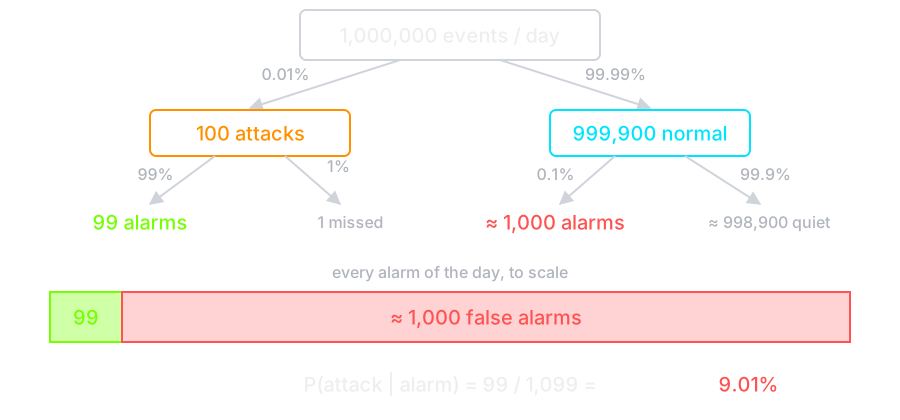
The Base-Rate Fallacy
- When the thing you are looking for is rare, the false-alarm rate dominates — however good the detector is
- This is why analysts stop reading alerts, and why the alert that mattered was in the queue all along
- What actually helps:
- Raise the base rate — watch a narrower, higher-value population rather than everything
- Correlate — require two weak signals, so the false-alarm rates multiply
- Drive the false-alarm rate down, even at the cost of detection. 0.01% would change the table above tenfold
In the Wild: Target's Alarms, 2013
- Attackers stole data from 40 million payment cards, plus up to 70 million customer records
- Target's FireEye system did flag the malware, with urgent alerts as each version was installed
- Nobody acted, and the option to delete the malware automatically was not
turned on. The alert was named only
malware.binary - The Senate report's own guess: staff may have read it as a false alarm, if the system alarmed often — the base-rate fallacy, at work
Detection will miss. So limit the damage: when this host falls, what else falls with it?
Source: US Senate Commerce Committee, A "Kill Chain" Analysis of the 2013 Target Data Breach (2014)
Isolation You Can Buy
- A hypervisor runs several operating
systems on one machine, each believing it has the hardware
- Type 1 — on the bare metal. ESXi, Hyper-V, KVM. Small TCB, and what clouds run
- Type 2 — on top of a host OS. VirtualBox, VMware Workstation. The whole host OS joins your TCB
- For security the appeal is simple: a compromised VM is a compromised VM. The blast radius has a wall around it
- And snapshots make analysis cheap — run the malware, look, roll back
The Wall Has Doors
- VM escape — a bug in the hypervisor, usually in an emulated device, that gets code onto the host. Rare, and total
- Side channels — shared caches and shared branch predictors leak between tenants. Spectre and Meltdown were about exactly this
- Sprawl — a VM that is off is not being patched, and it comes back months out of date
- The management plane is the real target. Whoever holds the hypervisor console holds every guest, and the console is protected by a password
Containers Are Not Small VMs
- A container is a process on one kernel. Namespaces limit what it sees; cgroups limit how much it uses. There is no second operating system
- So a kernel bug is shared by every container on the host; VMs still have a hypervisor between them. Weaker isolation, far lower cost
- If you run them: non-root user, read-only root filesystem, dropped
capabilities (root's rights, in pieces), a seccomp filter on system
calls, and
never
--privileged - Where the boundary must be strong, put one back: a micro-VM (Firecracker, Kata) or a user-space kernel (gVisor)
Isolation, Drawn
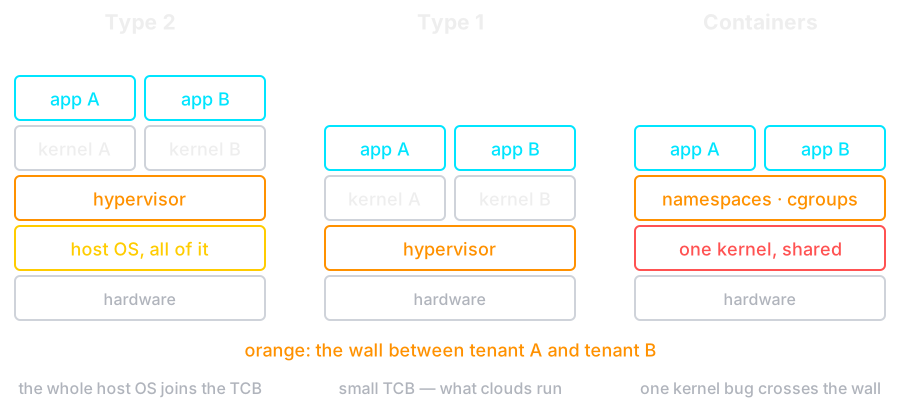
Ask of each one: what stands between tenant A and tenant B?
Two Distributions, One Kernel
$ uname -sr
Darwin 27.0.0
$ docker run --rm debian:bookworm uname -sr
Linux 7.0.14-linuxkit
$ docker run --rm quay.io/centos/centos:stream9 uname -sr
Linux 7.0.14-linuxkit
$ docker run --rm debian:bookworm sh -c 'ls /dev | wc -l'
15
$ docker run --rm --privileged debian:bookworm sh -c 'ls /dev | wc -l'
169
- Debian and CentOS, and one kernel under both — and it is not the Mac's. Docker Desktop runs a Linux VM: a hypervisor wall around the containers, and only a kernel between them
--privilegedtakes the container from 15 devices to 169: the VM's hardware, handed over in one flag
In the Wild: runc, 2019
runcstarts the containers under Docker, containerd, CRI-O and Kubernetes. CVE-2019-5736 let a container overwrite the host's runc binary- The next time runc ran, the attacker's code ran as root on the host — and every other container on it
- It needed root inside the container, usually from an untrusted image
- So the first item on Containers Are Not Small VMs was the defence: a non-root user, or user namespaces. RHEL's SELinux policy blocked it too
Source: Aleksa Sarai, CVE-2019-5736: runc container breakout (oss-security); Kubernetes, Runc and CVE-2019-5736
Check Yourself
- The grade service owns
server.log. Why doesuappndnot protect it, and what does? - Why did twenty
As makeis_admin1094795585, and why is the canary's crash an improvement? - A detector is 99% accurate, but 9 in 10 of its alarms are false. What was rare, and what is one fix?
- Two containers, then two VMs on a Type 1 hypervisor: what stands between the tenants in each case?
Where This Leaves Us
- The host is defended by the boring things: patch, minimise, separate, log — and a log the service cannot rewrite
- The bug classes that survive are the ones where data crossed into control — a buffer into a flag, a file into a privilege
- Isolation limits the damage; it never prevents the bug
Next: the same failure, on the most exposed application anyone runs — the one that takes input from every stranger on the internet.