Why a Standard Vocabulary?
- Lecture 1 ended on: name the property, name the threat, then pick the mechanism. Two engineers can still mean different things by "the channel is authenticated"
- ITU-T X.800 — the Security Architecture for OSI, published 1991, identical in substance to ISO 7498-2
- Lecture 1's passive and active attacks were already its words. Old, and still how requirements get written down: a requirement names a service, a design names a mechanism
The value is not the document. It is that everybody agrees on the service promised and the mechanism that delivers it.
Three Definitions
| Security attack | A threat someone carried out — lecture 1's word, unchanged |
| Security mechanism | A process designed to detect, prevent or recover from an attack |
| Security service | A capability that counters attacks, built from one or more mechanisms |
- A service is what you promise; a mechanism is how you deliver it
- "Confidentiality" is a service. "AES-256-GCM" is a mechanism. Never write the second where the first belongs
- A control is a mechanism put in place in a real system — the word risk management uses
The Five Service Categories
| Authentication | The other side is who it claims (peer entity); the data came from who it claims (data origin) |
| Access control | Prevent unauthorized use of a resource — lecture 4 |
| Data confidentiality | Protect from disclosure — including what traffic patterns reveal |
| Data integrity | The data arrives unchanged, or the change is detected |
| Non-repudiation | Of origin, or of delivery — neither side can deny it happened |
Availability is treated as a property of the system in X.800 rather than a service of its own — the one place the standard shows its age.
Specific Mechanisms
Eight, each sitting at a particular protocol layer:
- Encipherment — the maths of lecture 3
- Digital signature — unforgeable, and verifiable by anyone
- Access control — enforcing rights
- Data integrity — detecting modification
- Authentication exchange — a handshake that proves identity
- Traffic padding — filler, so the volume says nothing
- Routing control — choose a path you trust
- Notarization — a third party vouches for the exchange
Pervasive Mechanisms
Five more that belong to no layer, because they apply to the whole system:
- Trusted functionality — the part that is correct by assumption, so keep it small
- Security labels — the resource carries its own sensitivity
- Event detection — noticing that something security-relevant happened
- Security audit trail — the record you read afterwards
- Security recovery — what the system does in response
The last three are lecture 1's detect · respond · recover, thirty years earlier.
Services Are Built From Mechanisms
| Encipher | Signature | Integrity | Auth. exch. | Notary | |
| Peer authentication | ✔ | ✔ | ✔ | ||
| Data origin auth. | ✔ | ✔ | |||
| Confidentiality | ✔ | ||||
| Data integrity | ✔ | ✔ | ✔ | ||
| Non-repudiation | ✔ | ✔ | ✔ |
Read the bottom row: non-repudiation is the one service encipherment cannot provide. Only a signature binds a message to a single party.
The Same Code, Two Mechanisms
Lecture 1's fix, read with this lecture's eyes:
	if roles[user] != "instructor" {              // access control
		log.Printf("DENIED grade %s=%d by %s", id, grade, user)
		http.Error(w, "forbidden", http.StatusForbidden)
		return
	}
	grades[id] = grade
	log.Printf("grade %s=%d by %s", id, grade, user)  // security audit trail
- The
ifis a specific mechanism: access control, at one layer, in one place - The log is a pervasive one: the audit trail, which belongs to no layer and watches every request
- The check protects data integrity by blocking unauthorized writes; the audit trail records decisions for detection and investigation
- Nothing here helps the reader on the lab wifi. That service is confidentiality, its mechanism is encipherment, and it is lecture 3
From Vocabulary to Architecture
- X.800 tells you what to call things. An enterprise security architecture says where they go in your organization
- It answers, on one page each:
- What are the assets, and who owns each one?
- What are the zones, and what crosses between them?
- Which control enforces which requirement, and who operates it?
- Without it you get point solutions: nine products, six of them overlapping, and one gap nobody owns
You Cannot Protect What You Cannot List
- Asset inventory is unglamorous and it is the control that fails first
- Every breach report has the same sentence in it somewhere: "the server was not in the inventory"
- Each asset needs an owner, a classification, and a location
- Classification — public · internal · confidential · restricted
- The label decides which controls apply, so it must be a short list
- The CIS Controls, a priority list we meet below, put hardware and software inventory first and second — on purpose
Zones and Boundaries
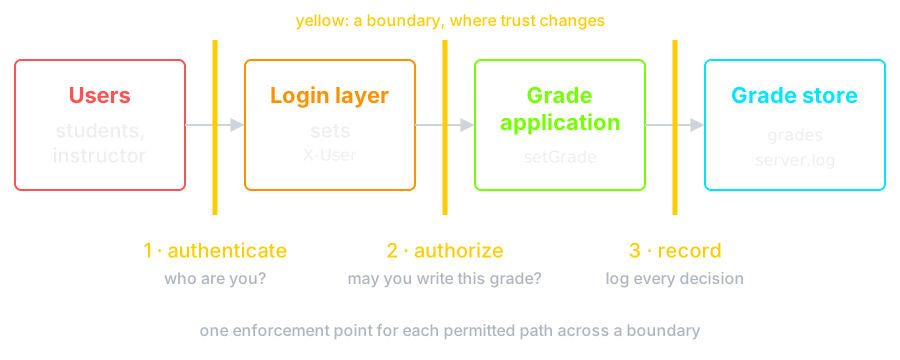
- A zone is a set of assets with the same trust level and the same policy. A boundary is where trust changes
- Draw them once and the firewall rules and the audit scope fall out of the same picture — lecture 7 builds this properly
A Boundary You Have Walked Through

The checkpoint controls passage between areas. In our grade service, the write endpoint is where permission must be checked.
Where would an unchecked side entrance appear in the application?
Layers of an Architecture
SABSA (Sherwood Applied Business Security Architecture) looks at one system from six views. Here, the grade service:
| Contextual | The business. Trustworthy grades and timely transcripts |
| Conceptual | The architect. Students read; instructors enter grades |
| Logical | The designer. Identity, write permission, and grade flows |
| Physical | The builder. Login integration, role check, HTTPS, logs |
| Component | The implementer. Server, database, and library versions |
| Operational | The operator. Owners, denied-write alerts, restore tests |
Requirements flow down. Assurance — evidence that each layer does its job — flows back up.
The Standards You Will Meet
| ISO/IEC 27001 | The requirements for an ISMS (next section). What you get certified against |
| ISO/IEC 27002 | The control catalogue — guidance, not requirements |
| NIST CSF | Govern · Identify · Protect · Detect · Respond · Recover |
| NIST SP 800-53 | A very large control catalogue, US federal in origin |
| CIS Controls | 18 controls in priority order. The best place to start |
| PCI DSS | Card data. Not optional if you touch it |
They overlap heavily. Pick one as the spine and map the others onto it.
Four Documents, Often Confused
We have assets and boundaries. Now state what is allowed and who owns the decision.
| Policy | What must be true, and who says so. Short. Signed by management |
| Standard | The specific, mandatory way — "TLS 1.2 or above" |
| Procedure | The steps, in order, for a human to follow |
| Guideline | Advice. The only one that is optional |
- Here, a standard is an organization's mandatory rule; external standards such as ISO 27001 can inform those rules
What a Policy Has to Contain
- Scope — who and what it binds
- Statement — the requirement, in the imperative
- Roles — who owns it, who enforces it, who may grant an exception
- Consequences — what happens when it is broken
- Review date — a policy with no review date is a historical document
If nothing in the organization would change when the policy is withdrawn, it was never a policy.
The ISMS Loop
- An Information Security Management System is the machinery that keeps policy connected to reality
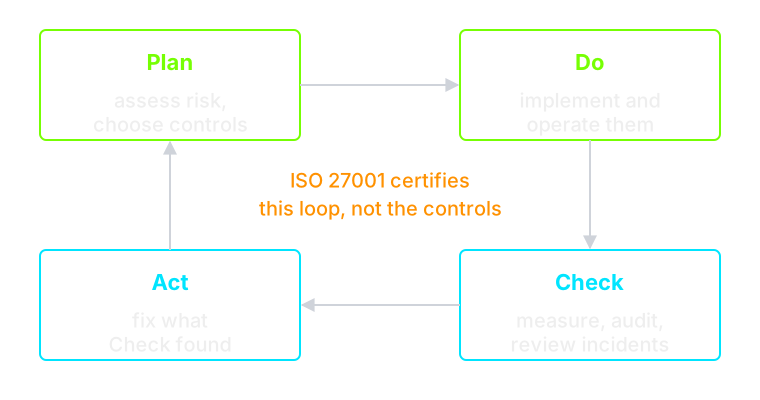
An organization can be certified and still be badly defended.
Why Policies Fail
- Nobody read it. Forty pages, once, at onboarding
- It forbids the job. If the rule blocks the work, the work wins — every time
- No exception process. Without a legitimate way to say "not here", people take the illegitimate one
- Never measured. An unaudited policy describes intentions, not systems
The best policy is the one that is enforced by a mechanism, so following it is the path of least resistance.
The Policy Is a Test
"Only the instructor of record may enter or change a grade." Written as a test, it runs on every commit:
func TestOnlyInstructorSetsGrade(t *testing.T) {
	req := httptest.NewRequest("POST", "/grade?id=4001&grade=20", nil)
	req.Header.Set("X-User", "4001") // a student
	rec := httptest.NewRecorder()
	setGrade(rec, req)
	if rec.Code != http.StatusForbidden {
		t.Fatalf("a student changed a grade: HTTP %d", rec.Code)
	}
}
$ go test ./...                 # lecture 1's first version
2026/10/06 01:01:24 grade 4001=20 by 4001
--- FAIL: TestOnlyInstructorSetsGrade (0.00s)
    main_test.go:16: a student changed a grade: HTTP 200
FAIL
FAIL	grades	0.111s
FAIL

$ go test -count=1 ./...        # with the check in place
ok  	grades	0.219s
A policy that runs on every commit cannot be forgotten.
You Cannot Fix Everything
- Budgets are finite and vulnerabilities are not. Risk management is the discipline of deciding what not to fix
- Risk appetite — how much risk the organization agrees to carry. Above it, act; below it, accept
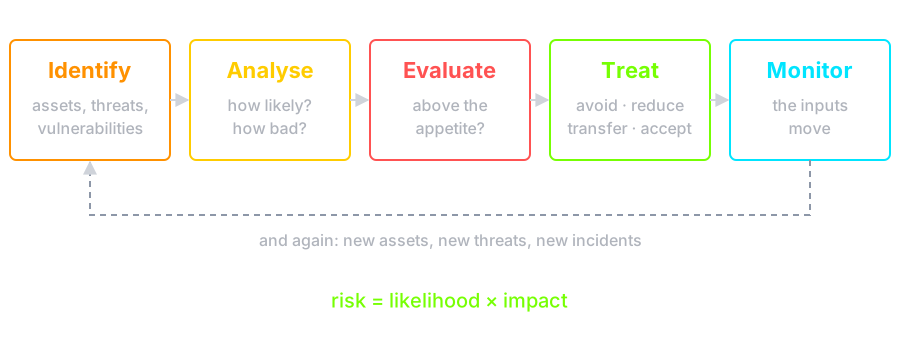
The loop, from ISO 27005 and NIST SP 800-30.
Qualitative or Quantitative?
- Qualitative — high / medium / low on a
5×5 matrix
- Fast, needs no data, and everyone can join in
- "High" is not a number — you cannot add two of them, or compare across teams
- Quantitative — money per year
- Comparable, and speaks the language of the budget holder
- Needs frequency data that most organizations simply do not have
- In practice: qualitative to triage, quantitative for the few decisions big enough to deserve it
Putting a Number On It
- SLE — single loss expectancy = asset value × exposure factor (the fraction of the value one event destroys)
- ARO — annualized rate of occurrence, how many times a year
- ALE — annualized loss expectancy = SLE × ARO
The control is worth buying when it costs less than the ALE it removes. That is the entire argument, and it can be written down.
The Control That Does Not Pay
asset_value  = 400_000      # the customer database, if it leaks
exposure     = 0.35         # fraction of that value one breach destroys
frequency    = 0.40         # breaches per year, from history

sle = asset_value * exposure
ale = sle * frequency
SLE = 400,000 x 0.35      =      140,000
ALE = 140,000 x 0.4       =       56,000 per year
So Do We Buy It?
Assume the control cuts breach frequency by 75%, from 0.40 to 0.10 per year. Loss per breach stays the same.
ALE after control              =       14,000 per year
value of the control          =       42,000 per year
cost of the control           =       60,000 per year
net                           =      -18,000 per year
- A control that works exactly as advertised, and it still loses money
- Now the argument is about the inputs — is the database really worth 400,000? — which is the argument worth having
Four Things To Do With a Risk
| Avoid | Stop doing the activity. Do not collect the data at all |
| Reduce | Apply a control. The one everyone thinks of first |
| Transfer | Insurance, or a contract. Moves the cost, never the duty |
| Accept | Decide it is tolerable — in writing, with a named owner |
- What is left after treatment is residual risk, and someone senior has to sign for it
- Ignoring a risk is not accepting it. Accepting it has a signature on it
Is the Check Worth It?
Lecture 1 asked which failure is worst. Priced like the customer database:
check_cost = 1_000          # one developer-day, paid once
sle        = 5_000          # one hearing, one reissued transcript
aro        = 2              # assumed successful changes per year without control

ale = sle * aro
ALE               = 5,000 x 2  =   10,000 per year
check pays back in  36 days
- Reduce: a day of work against 10,000 a year. The check is bought
- The deadline-day outage costs one extended deadline a year. A second server costs more than that. Accept, in writing, with a name on it
What the Numbers Cannot Do
- Frequency for a rare, deliberate event is not a frequency you can measure. An adversary is not weather
- Reputational and human impact resist pricing, and get left out of the model precisely because they resist pricing
- The model is a way to make assumptions explicit and arguable — not an oracle
- A wrong estimate and an accepted risk end the same way: one day, it happens
All models are wrong, but some are useful. — George Box
When It Happens Anyway
- Event — anything observable
- Alert — an event worth a look
- Incident — an event that actually harmed confidentiality, integrity or availability
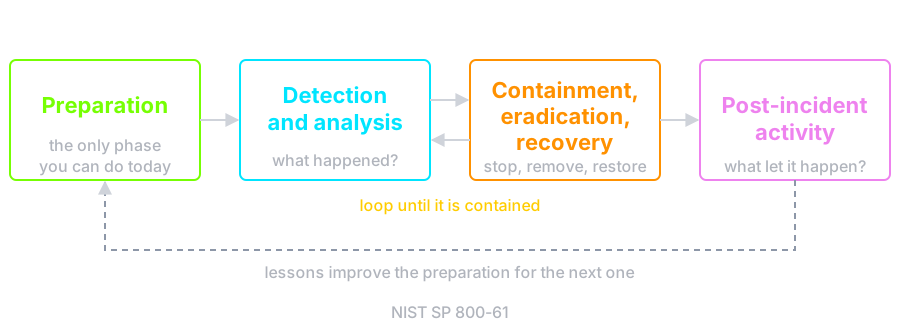
Preparation Is the Whole Game
- A named team, reachable out of hours and out of band — if the corporate mail is compromised, do not run the response on corporate mail
- Logs that already exist, centralized, with a retention long enough to cover the gap between breach and discovery
- Decisions made in advance: who may disconnect production, who talks to the press, when law enforcement is called
- Rehearsed. A tabletop exercise finds the missing phone number before the night you need it
Practice Before the Emergency
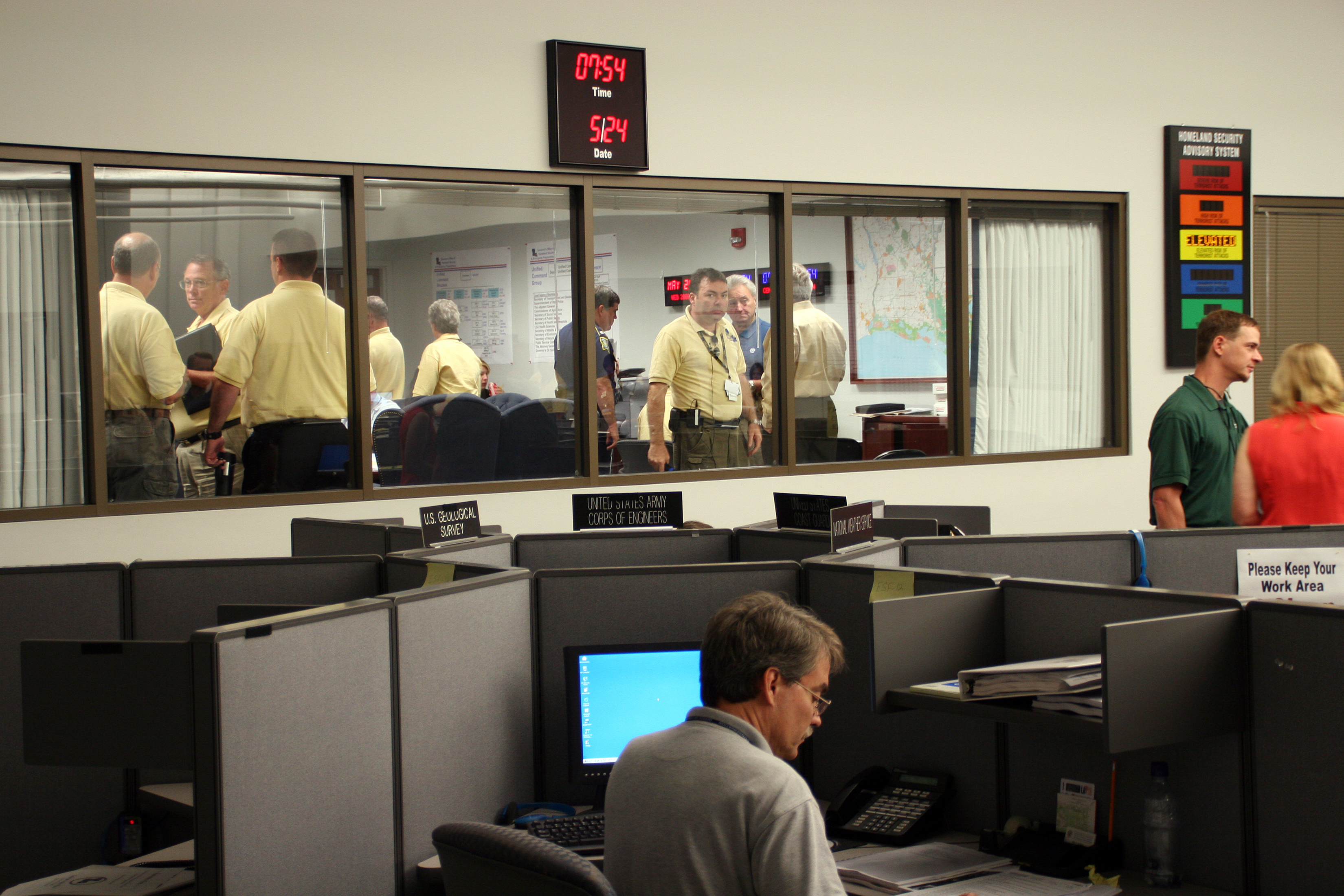
A disaster-response exercise illustrates the same preparation problem: people, communications, and authority must work together before an incident.
If the grade service fails tonight, who can stop writes and who tells students?
Containment Is a Trade-Off
- Pull the plug and you stop the damage — and destroy the evidence, and tell the attacker they are seen
- Watch and learn and you keep the evidence — and the damage keeps running
- Short-term containment stops the bleeding; long-term containment is the clean rebuild
- Eradication means the cause is gone, not the symptom. Restoring a backup onto the same unpatched host is not eradication
- Preserve volatile evidence first: memory, then disk, then logs
Afterwards
- A post-incident review within two weeks, while people still remember
- Blameless. The question is what let a
mistake become an incident, not who made it
- Blame produces silence, and silence is how the next one goes undetected
- Output is a small number of dated actions with owners
- Feed it back into the risk register — the written list of risks, owners and decisions. An incident is measured frequency data, the thing the model was missing
Business Continuity
- Incident response saves the system. Business continuity keeps the organization running while the system is gone
- It starts with a Business Impact Analysis: which processes matter, and how long can each be down
- Two numbers per process, and they are not the same number
- RTO — recovery time objective: how long until it is back
- RPO — recovery point objective: how much data you can afford to lose
- An RPO of one hour means backups every hour. The number is the requirement
Backups, Honestly
- 3-2-1 — three copies, on two kinds of media, one of them off-site
- At least one copy offline or immutable — ransomware looks for the backup server first, and it is usually reachable with the same credentials
- An untested backup is not a backup. Restore one on a schedule, and time it — that measured time is your real RTO
- Encrypt them. A backup tape is a copy of everything, in a box, in a van
Storage Is Only One Part of Recovery
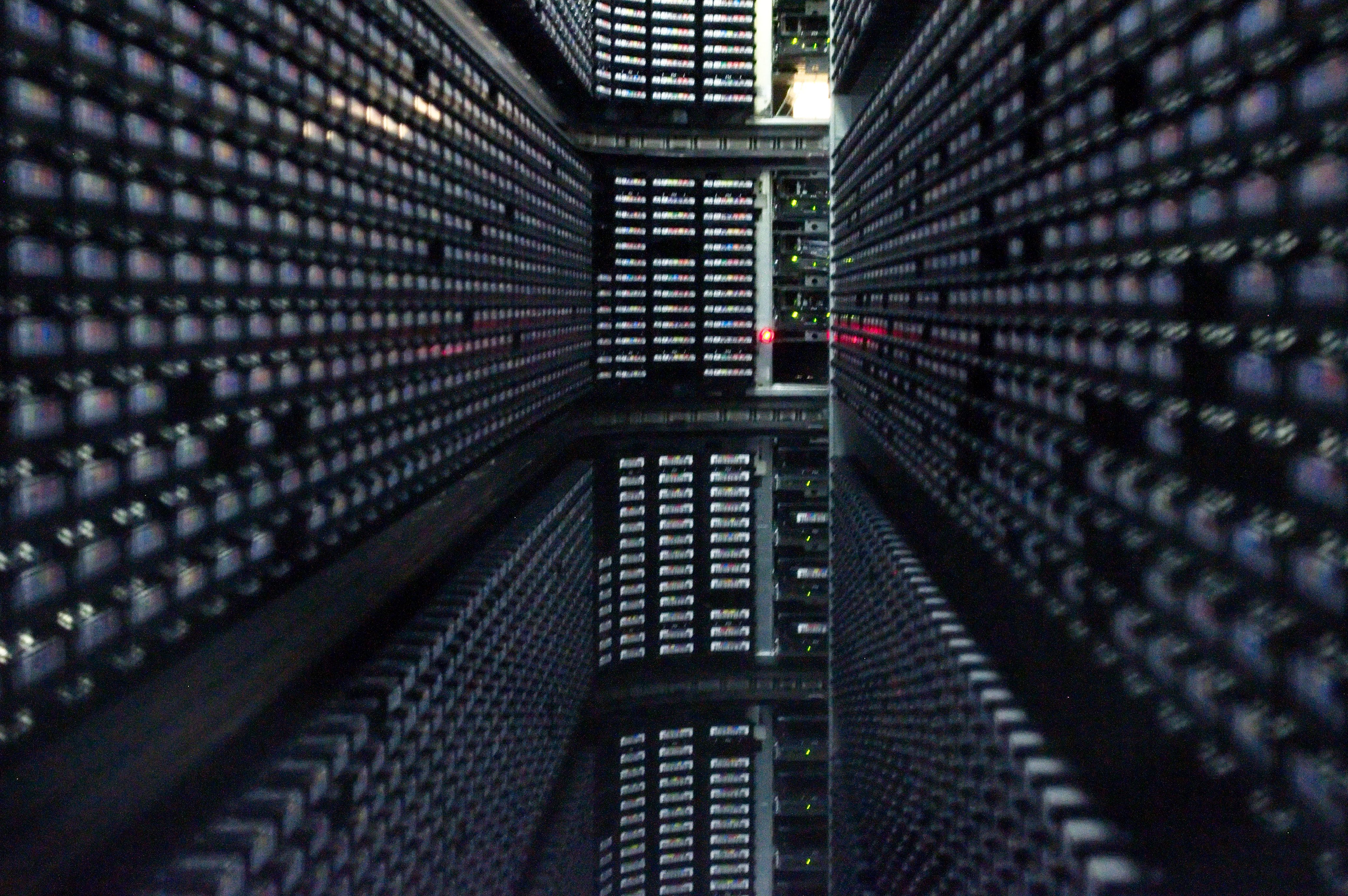
Tape makes the extra copy tangible. A cartridge inside a connected library is not automatically offline or off-site; recovery still needs a tested restore.
Could we restore the grade service within its RTO, and how much data would we lose?
The Day It Happens
Reconstruct lecture 1's incident, before the role check was deployed:
$ grep -v 'by parham' server.log
2026/10/06 01:01:23 grade 4001=20 by 4001
- Alert: the nightly grep finds a grade changed by someone who is not the instructor
- Incident: the instructor confirms it was not them. Freeze grade entry, copy the log before touching anything
- Eradicate: deploy the check. The test is green. Recover: verify the original 12 against the instructor's grade record, then restore it. This log records the new value, not the old one
- Afterwards: run the regression test on every commit. Record this incident with its date in the risk register and revisit the assumed annual frequency
One program, two lectures. Every idea had a line of code.
Names to Keep: X.800
Name the promise before choosing its implementation.
| X.800 / ISO 7498-2 | The shared vocabulary for attacks, services, and mechanisms |
| Attack · service · mechanism | What compromises security · what we promise · how we deliver it |
| Authentication | Peer entity: who is communicating; data origin: who sent the data |
| Access control | Prevent unauthorized use of a resource |
| Data confidentiality | Prevent disclosure, including information revealed by traffic flow |
| Data integrity | Protect against unauthorized modification |
| Non-repudiation | Evidence of origin or delivery |
| Availability | A system property; not a separate X.800 service category |
Names to Keep: Mechanisms
Specific mechanisms act at a layer; pervasive mechanisms support the whole system.
| Encipherment · digital signature | Hide data · bind a message to a signer |
| Access control · data integrity | Enforce rights · detect modification |
| Authentication exchange | Establish identity through an exchange |
| Traffic padding · routing control | Obscure traffic patterns · select an appropriate path |
| Notarization | A trusted third party supplies evidence |
| Trusted functionality · security labels | Trusted system functions · sensitivity markings |
| Event detection · security audit trail · security recovery | Notice events · record them · restore security |
Names to Keep: Architecture
Locate the assets, trust boundaries, controls, and owners.
| Enterprise security architecture | Connect requirements to controls and the people operating them |
| Asset inventory · classification | List assets and owners; label public / internal / confidential / restricted |
| Zone · boundary | Group assets under a common trust policy · control where trust changes |
| SABSA | Six architectural views of the same system |
| Contextual · conceptual | Business needs · domains, trust, and principles |
| Logical · physical | Services, policies, and flows · mechanisms and protocols |
| Component · operational | Products and versions · operation and measurement |
Names to Keep: Standards
Use this as a reference map when a name appears again.
| ISO/IEC 27001 | Requirements for an Information Security Management System (ISMS); certifiable |
| ISO/IEC 27002 | Guidance on information security controls |
| NIST CSF | Cybersecurity Framework: Govern · Identify · Protect · Detect · Respond · Recover |
| NIST SP 800-53 | Security and privacy control catalogue |
| CIS Controls | Prioritized controls; hardware and software inventories come first |
| PCI DSS | Payment Card Industry Data Security Standard: card-data protection |
| ISO 27005 · NIST SP 800-30 | Risk-management guidance · risk-assessment guidance |
| NIST SP 800-61 | Incident-response guidance |
Names to Keep: Policy
Turn a requirement into an owned, enforced, and reviewed rule.
| Policy | What must be true, approved by management |
| Standard · procedure · guideline | Mandatory specifics · ordered steps · optional advice |
| Scope · statement | Who and what the policy covers · what it requires |
| Roles · consequences · review date | Who owns, enforces, and grants exceptions · response to violations · when to review |
| ISMS | Information Security Management System: keep policy connected to reality |
| Plan · Do · Check · Act | Assess and choose · operate · measure · improve |
Names to Keep: Risk
Make the assumptions explicit, then decide how to treat the risk.
| Likelihood · impact · risk appetite | How likely · how bad · how much risk the organization will tolerate |
| Identify · analyse · evaluate · treat · monitor | Find risks · estimate them · compare · act · revisit |
| Qualitative · quantitative | Rank risks with categories · estimate loss in money per year |
| Exposure factor · SLE | Fraction of asset value lost · single loss expectancy = value × exposure |
| ARO · ALE | Annualized rate of occurrence · annualized loss expectancy = SLE × ARO |
| Avoid · reduce · transfer · accept | Stop the activity · apply controls · shift financial cost · approve the risk |
| Residual risk · risk register | Risk left after treatment · the record of risks, owners, decisions, and evidence |
Names to Keep: Incidents & Continuity
Prepare to respond, and keep the organization working during recovery.
| Event · alert · incident | An observation · a signal to investigate · a security failure requiring response |
| Preparation · detection and analysis | Arrange team, logs, and authority · investigate and establish what happened |
| Containment · eradication · recovery | Limit damage · remove the cause · restore safe operation |
| Post-incident activity · tabletop exercise | Review and assign improvements · rehearse decisions before an emergency |
| Business continuity · BIA | Keep business processes running · Business Impact Analysis identifies priorities |
| RTO · RPO | Recovery time objective: target downtime · recovery point objective: tolerable data loss |
| 3-2-1 · offline · immutable | Three copies, two media, one off-site · disconnected · protected from alteration |
Check Yourself
- In the grade service, which line is a specific mechanism and which is a pervasive one? Which service does each support?
- A control removes 30,000 of ALE a year and costs 40,000 a year. Do you buy it, and what is the next argument?
- The nightly grep finds a grade changed by a student. Which phase are you in, and what are the first two things you do?
- "We can lose at most the last hour of grades." Is that an RTO or an RPO?
Where This Leaves Us
- We can now name a requirement as a service, write it as policy, justify it with risk, and plan for the day it fails
- Every one of those services eventually rests on the same small set of mechanisms — and most of those are cryptography
- One program carried every idea: the check is a mechanism, the test is the policy, the price says buy it, and the log made the incident visible
Next: the toolbox. What encryption, hashing and signatures actually guarantee — and what they do not.