Parham Alvani
9 years building backend systems
4 of them on platform and infrastructure

How to Reach Me
parham [dot] alvani [at] gmail [dot] com
- Start the subject with [IS], then say what it is about
- Include your student ID — it is how anything about grades gets looked up
- One question per email. Long threads get lost; short ones get answered
No instant messaging
Email is awesome
- Searchable — you can find what I said three months ago
- Asynchronous — neither of us owes the other an answer at 2am
- On the record — “but you said the deadline moved” becomes checkable
This Course
- Security is not a feature you add. It is a property of the whole system, and it is only as good as its worst part
- Four questions we keep coming back to
- What are we protecting, and from whom?
- What could go wrong, and how badly?
- What does the defence cost — in money, and in usability?
- How do we know it is working?
- Engineer's approach: understand the mechanism, then decide where to spend
What This Course Is Not
- Not a list of tools to run against
machines you do not own
- Every attack here is taught so you can defend against it — you cannot defend what you do not understand
- Not a cryptography course. We use
cryptography as a toolbox; we do not prove
it secure
- The rule for this course: never invent your own
- Not a product catalogue. Vendors and version numbers change; the failure modes do not
Prerequisites
- Computer networks — you should be able to read an IP header and explain what a port is
- Operating systems — processes, users, file permissions, the kernel/user split
- Programming — enough to read C, Go and a little Python. You will not be asked to write much
- Everything else is introduced here, including all the cryptography
What Are We Protecting?
Before any mechanism, name the property. Almost every requirement in this course is one of three.
| Confidentiality | Only those authorized can read it |
| Integrity | Only those authorized can change it — and you can tell |
| Availability | Those authorized can actually use it, when they need to |
The CIA triad. Every control we meet serves one of them.
The Same System, Three Failures
A university grade database:
- Confidentiality — a student reads everyone else's grades
- Integrity — a student changes their own grade from 12 to 20
- Availability — nobody can submit grades on the day of the deadline
Which is worst? It depends on the system — and deciding that is called risk management (lecture 2).
Three Is Not Always Enough
- Authenticity — this really did come from who it claims to
- Non-repudiation — and the sender cannot
later deny it
- Needs a digital signature: a check anyone can verify but only the sender could make (lecture 3)
- Accountability — every action traces back to a responsible identity
- Privacy — the subject keeps control over data about them, which is not the same as confidentiality
FIPS 199 defines confidentiality, integrity and availability; authenticity and accountability are added by NIST SP 800-33.
Integrity, in One Command
A hash function turns any input into a short fingerprint, the digest:
$ cat order.txt
transfer 100 USD to alice

$ shasum -a 256 order.txt
918e1e440fd83a713e79f2bcfcdecedb1145a7e94dba18ae71c9a9f886a7bb26  order.txt

$ sed -i '' s/100/900/ order.txt      # change one character

$ shasum -a 256 order.txt
73d418b01e29a3ec522895c90d805794864d516a5603644e426adbd21a3111d9  order.txt
One digit moved, and every digit of the digest moved with it. That is what "you can tell" means.
But Who Guards the Digest?
- An attacker who can rewrite the file can rewrite the digest next to it
- A hash gives integrity against accident; it takes a key to get integrity against an adversary
- This pattern repeats all term: a mechanism only moves the problem, and the question is where it moved to
Security is not a product, but a process. — Bruce Schneier, 2000
Say It Precisely
These five words are used interchangeably in the press. Not here.
| Asset | Something with value: data, a service, a reputation |
| Vulnerability | A weakness in the asset or its controls |
| Threat | A potential cause of harm — needs an actor and a motive |
| Attack | A threat that someone actually carried out |
| Risk | How likely, and how bad — the number we manage |
A vulnerability with no threat is a curiosity. A threat with no vulnerability is noise.
Passive and Active
The oldest useful split. Lecture 2's standard, X.800, uses exactly these names:
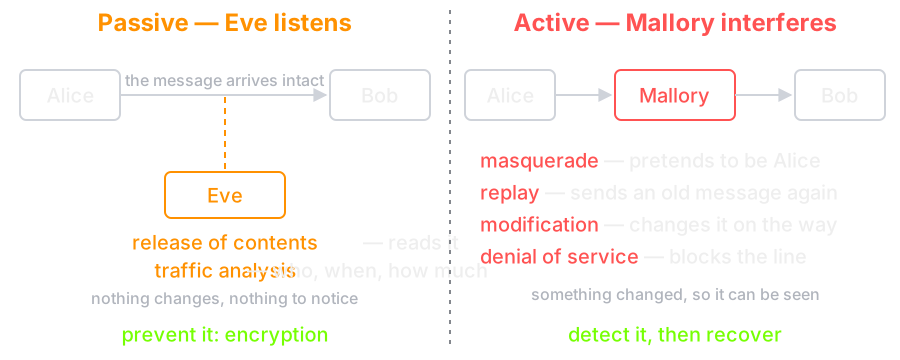
Passive changes nothing, so there is nothing to notice: you prevent it. Active you cannot always prevent: you detect it and recover.
Traffic Analysis Is Not Nothing
- Encryption hides what was said. It does not hide that it was said
- Who talked to whom, when, how often, how much — the metadata
- A phone that contacts an oncology clinic weekly has leaked something, and every byte was encrypted
- Countermeasures are expensive: traffic padding, cover traffic, mixing. This is why they are rare
Metadata, in One Command
$ openssl s_client -connect example.com:443 -servername example.com \
      -msg </dev/null 2>&1 |
    awk '/ClientHello/{p=1;next} /^[<>]/{p=0} p' | xxd -r -p |
    xxd | grep -B1 -A1 example

00000080: 3c00 3500 2f01 0005 78ff 0100 0100 0000  <.5./...x.......
00000090: 0010 000e 0000 0b65 7861 6d70 6c65 2e63  .......example.c
000000a0: 6f6d 000b 0002 0100 000a 0012 0010 11ec  om..............
The first packet of the connection, sent before any key exists. Every byte of the request that follows is encrypted; the name of the site is not, because the server must know which site you want before it can answer. Metadata is not a leftover — it is structural.
Who Is the Attacker?
A threat model names who attacks and what they can spend. "A hacker" is not one.
| Opportunist | Automated scanning. Takes whatever is unpatched and reachable |
| Insider | Already authenticated, already inside. Hardest to stop |
| Organized crime | Ransomware, fraud. Follows the money and is patient |
| State actor | Buys unknown bugs (zero-days), attacks your suppliers, will not give up |
Defending against all four to the same standard is how budgets are wasted.
Attack Surface
- Every place untrusted input can reach your system: open ports, HTTP parameters, file uploads, USB slots, help desk staff
- The first and cheapest defence is always to
make it smaller
- Turn the service off · close the port · remove the feature
- Code that is not there has no vulnerabilities
- Attack tree: put the goal at the root, the ways to reach it beneath, and keep asking "how?" until the leaves are things a person could actually do
STRIDE
A checklist for "what could go wrong here", one letter per property:
| Spoofing | pretending to be someone | → authenticity |
| Tampering | changing data | → integrity |
| Repudiation | denying you did it | → non-repudiation |
| Information disclosure | reading what you should not | → confidentiality |
| Denial of service | taking it away | → availability |
| Elevation of privilege | becoming admin | → authorization (who may do what) |
Draw how data moves through the system, and ask all six wherever it crosses from one owner to another.
No Single Wall
- Every control fails eventually — it is misconfigured, out of date, or simply bypassed
- Defence in depth: arrange controls so that no single failure is fatal
- The castle analogy is popular and slightly wrong: a moat only helps if the attacker comes by the gate. Most arrive by email
Assume the outer layer is already broken. What does the next one do?
The Layers
| Physical | Locks, racks, guards. Console access beats every other control |
| Network | Zoning, firewalls, VPN, segmentation — lecture 7 |
| Host | Hardening, patching, anti-malware, host IDS — lecture 5 |
| Application | Authentication — lecture 4. Input handling, sessions — lecture 6 |
| Data | Encryption at rest and in transit, key management — lecture 3 |
| People | Training, policy, process. The layer that is always attacked |
Four Kinds of Mechanism
Whatever the layer, a control does one of four jobs. A programme with only the first is not a programme.
- Prevent — stop it happening. Access control, encryption, input validation
- Detect — notice that it happened. Logs, intrusion detection (IDS), file-integrity monitoring
- Respond — contain it. Isolate the host, revoke the key, block the address
- Recover — get back to normal. Backups, failover, the rebuild you have actually rehearsed
Prevention is preferred, detection is mandatory, recovery is survival.
Principles Worth Memorizing
| Least privilege | every subject gets the rights it needs, and no more |
| Fail-safe defaults | deny unless explicitly allowed — default deny |
| Economy of mechanism | a simple design is one you can actually check |
| Complete mediation | check every access, not just the first |
| Open design | security must not depend on the design being secret |
| Separation of privilege | two keys are better than one |
| Least common mechanism | every part users share is a path between them |
| Psychological acceptability | if the secure way is hard, people take the other way |
Saltzer and Schroeder, 1975. They have not needed revising.
The Awkward Truths
- The attacker only has to be right once. You have to be right every time — but you also get to watch, and they do not
- Security is a trade-off. A control that makes the job impossible will be worked around, and then you have neither security nor the control
- Complexity is the enemy. Every feature, dependency and integration is more surface
- There is no perfect. The goal is to make the attack cost more than the asset is worth
The Grade Service
Everything in this lecture, on one program. A grade service with a single endpoint; who the caller is comes from the login layer in front of it, and today we trust that header.
var grades = map[string]int{"4001": 12, "4002": 17}

func setGrade(w http.ResponseWriter, r *http.Request) {
	user := r.Header.Get("X-User") // filled in by the login layer in front
	if user == "" {
		http.Error(w, "login first", http.StatusUnauthorized)
		return
	}
	id := r.FormValue("id")
	grade, _ := strconv.Atoi(r.FormValue("grade"))
	grades[id] = grade
	log.Printf("grade %s=%d by %s", id, grade, user)
	fmt.Fprintf(w, "%s is now %d\n", id, grade)
}
The Attack, in One Request
$ curl -H 'X-User: parham' -d 'id=4002&grade=18' localhost:8080/grade
4002 is now 18

$ curl -H 'X-User: 4001' -d 'id=4001&grade=20' localhost:8080/grade
4001 is now 20

$ tail -1 server.log
2026/10/06 01:01:23 grade 4001=20 by 4001
- Student 4001 just gave themselves a 20. The property that broke is integrity
- The vulnerability is the
if: it asks "are you logged in?", never "are you allowed to set grades?" - The threat is anyone with a student login. The attack is this one request, and it is active: something changed
- The risk is how often this happens and what it costs. Lecture 2 puts a number on it
The Fix, and the Log
var roles = map[string]string{"parham": "instructor", "4001": "student"}

	if roles[user] != "instructor" {
		log.Printf("DENIED grade %s=%d by %s", id, grade, user)
		http.Error(w, "forbidden", http.StatusForbidden)
		return
	}
$ curl -H 'X-User: 4001' -d 'id=4001&grade=20' localhost:8080/grade
forbidden

$ head -1 server.log
2026/10/06 01:01:25 DENIED grade 4001=20 by 4001
- The check prevents, at the application layer. The log detects, and it lives on the host, where no student can reach it
- The reader on the lab wifi is a passive attack; no check stops it. That needs encryption: the primitives are lecture 3, TLS is lecture 6
- No single wall: the check can be wrong again. The log is the layer that says so. Lecture 2 picks up this same program
Syllabus
- Introduction — concepts, threats, attacks, layers
- Security Architecture — X.800, policy, risk, incidents
- Cryptography — symmetric, public key, signatures, PKI
- Access Control — the four A's, DAC/MAC/RBAC, passwords, second factors, biometrics
- System & Software Security — file systems, malware, host defences, virtualization
- Web Security — server side, sessions, client side, TLS
- Network & Transport Security — zoning, edge, VPN, VLAN
Lectures 1–2 build the vocabulary, 3–4 the tools, 5–7 spend them on real systems.
Grading
| 35% | Midterm exam |
| 35% | Final exam |
| 30% | Homework and hands-on assignments |
- A 40% minimum on each exam, independent of the total
- The hands-on work is where the material actually lands. Do it
The Lab Rule
Only ever attack a system you own, or one whose owner has given you written permission.
- Every exercise in this course runs against your own machine or a target we provide
- Scanning, probing or exploiting university, ISP or third-party systems is not coursework — it is a criminal offence, and it will be treated as one
- Unsure whether something is in bounds? Ask before you run it, not after
Academic Honesty
- Discuss ideas freely. Write your own answers and your own code
- Cite what you used — a source, a tool, a model. Citing costs nothing; hiding it costs the assignment
- Copied work scores zero for everyone involved, including whoever shared it
The subject of this course is trust. It would be strange to start by breaking it.
Check Yourself
- Student 4001 set their own grade to 20. Which property broke, and which line of the grade service was the vulnerability?
- Why does a digest stored next to a file not stop an attacker who can edit the file?
- Encryption hides the request. Name one thing it does not hide, and say why.
- The role check prevents and the log detects. Why keep both?
Where This Leaves Us
- Name the property — confidentiality, integrity or availability. The grade service lost integrity
- Name the threat — who attacks, with what budget, through which part of the attack surface
- Then pick the mechanism — and expect it to fail, so layer it: prevent, detect, respond, recover
Next: lecture 2 turns this vocabulary into a standard one — X.800 — then writes it down as policy, prices it with risk management, and plans for the day it goes wrong.
Name the property. Name the threat. Then pick the mechanism.